


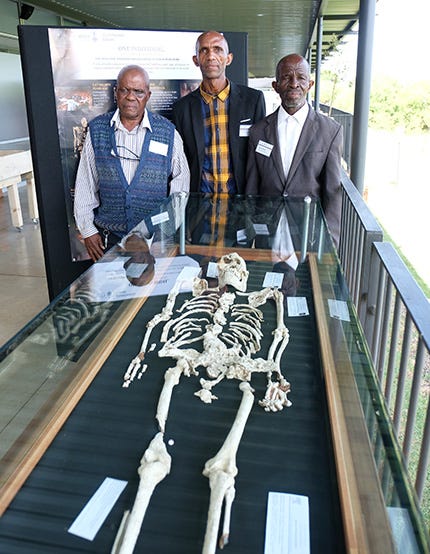
Fourteen fossil technicians whose skill, dedication and work helped uncover some of the world’s most important evidence of human origins will be honoured as Wits University celebrates 90 years of research at the Sterkfontein Caves on 16 November 2026, which began with Dr Robert Broom’s discovery of the first known adult Australopithecus in 1936.
These technicians have spent decades, often working long hours in cramped and difficult conditions, excavating and preparing the fossils behind the research that taught the world much of what we currently know about human origins and evolution. The contributions of technicians, past and present, have been central to the discoveries that have made the Sterkfontein Caves internationally famous.
These discoveries include hundreds of Australopithecus fossils found since 1966 when Professor P.V. Tobias began the first Wits University systematic work at the site with the direction of chief technician Alun R. Hughes. They also include the 1997 discovery of the world’s most complete skeleton with skull of Australopithecus, Little Foot.
The event, Sterkfontein at 90: From Fossils to Futures, will recognise not only their role in scientific discoveries, but also the specialist knowledge and skills passed down through generations of technicians.
Among those being honoured is retired technician Abel Molepolle, who was born in a tent at the Sterkfontein excavation site in 1967, where his father, David, worked as a fossil technician.
Abel joined the team in 1999 and spent more than 25 years excavating, preparing and making moulds and casts of fossils, including the famous Little Foot skeleton from the Silberberg Grotto in the Wits Sterkfontein Caves.
Molepolle proudly tells the story of how Professor Ronald Clarke gave Molepolle’s predecessors, Nkwane Molefe and Stephen Motsumi, the cast of the end of a shin bone and told them to go into the grotto to find the rest of the fossil.
After only a day and a half of searching with small lamps in the dark, they found in the breccia the connection to the rest of the shin bone of Little Foot. This connection led to many years of excavation, cleaning and reconstruction of this virtually complete Australopithecus.
Molepolle spent the next eight years of his life in the grotto, assisting Motsumi and Clarke in excavating the fossil, before moving to the laboratory for another eight years of work.
“I cleaned every piece, then I made a mould of it and then a cast so that we have a copy of every fragment in case it ever gets lost,” said Molepolle of his work.
Both father and son are among the 14 people being recognised.
Sterkfontein’s heritage also lives on through generations of families who have worked at the caves. Nkwane Molefe’s son, Shadrack, grew up visiting the site during school holidays before following in his father’s footsteps as a fossil technician.
The late Simon Sekowe served for many years as the overall Sterkfontein excavation foreman. His son, Lucas, is now the longest-serving technician on the current Sterkfontein team. Similarly, the late Isaac Makhele, the last foreman of the Sterkfontein excavations, passed on a family legacy of fossil excavation to his son, Sipho, who is also a member of the current team.
Professor Ronald Clarke, whose work led to Little Foot’s discovery and excavation, says the role of technicians has always been indispensable:
“The arduous work, powers of observation, and skills of fossil technicians have always played an essential role in producing the specimens that become the subject of scientific papers and student theses,” says Clarke.
He recalls how, as early as 1950, Dr Robert Broom praised his museum technician Daniel Mosehle, writing: “As a fossil hunter he is worth his weight in gold.”
“August this year marked the 90th anniversary of Dr Robert Broom’s discovery at Sterkfontein Caves of the world’s first known adult Australopithecus cranium, TM 1511. This discovery set in motion research at Sterkfontein that has continued to produce important fossils. December this year will mark the 60th anniversary of the start of Wits University’s continuous programme of excavation and research at the site,” says Clarke.
“This project produced hundreds of fossils of Australopithecus, including the world’s first virtually complete skeleton for this genus, Little Foot (StW 573), as well as many thousands of fossils of other fauna. This, together with stratigraphic studies and the application of cosmogenic burial dating, has contributed to a clearer understanding of human ancestry represented at Sterkfontein, and how these fossil species compare with those in East Africa.”
Wits archaeology Professor Kathleen Kuman says the technicians were also instrumental in recognising and excavating ancient tools of the Earlier Stone Age:
“In the early 1990s, Sterkfontein broke new ground, both figuratively and literally, in yielding the oldest stone tools in southern Africa in deeper excavations in tool-bearing breccia, just west of the deposits with Australopithecus fossils now that are now dated to ca 3.4 million years old. T
“hese were the first Oldowan artefacts in southern Africa, dating to ca 2.2 million years. While the site had already been well known for its early Acheulean artefacts ca 1.5 million years old, this work revealed how very widespread our early tool-making ancestors were on the African continent,” says Kuman.
“These discoveries would not have been possible without the efforts of our valued team of technicians, working tirelessly in excavating cemented deposits and extracting the tools,” says Kuman.
The 14 technicians being recognised are Abel Molepolle, David Molepolle, Nkwane Molefe, Meshaka Makgotokgo, Stephen Motsumi, Solomon Seshoene, Hendrick Dingiswayo, Clopus Seshoene, Shadrack Molefe, Sipho Makhele, Isaac Makhele, Simon Sekowe, Lucas Sekowe and Andrew Phaswana.
Several of these technicians are being honoured posthumously, while others are retired or remain active in fossil research.
©Higher Education Media Services.