


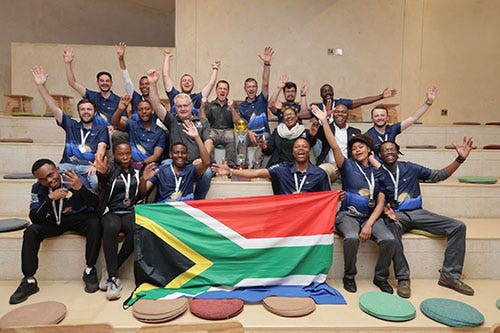
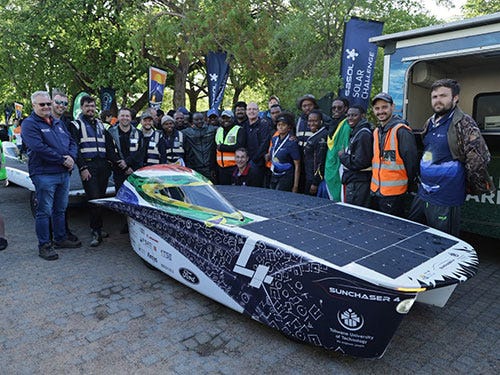
For eight days, 11 TUT engineering students took a temporary leave from their classrooms and hit the road – literally. These students were part of the TUT-winning SunChaser 4 team in the 2026 Sasol Solar Challenge.
The tyres hit the road at Sasolburg on 10 September 2026 at 9am and 2 369.2km later, the team of students, lecturers and engineers from Ford Company crossed the winning line in Paarl. That was eight days later, at Agter Paarl Road in Paarl, at 3.17pm on 17 September 2026.
SunChaser team are awarded for the Sasol Solar Challenge for 2026 at an awards ceremony held at Green School in Paarl.
Among the many lessons the students learned through this encounter was that there were no neat textbook answers when the wind picked up. There was no ready-made answer when a component needed attention, or a new problem surfaced just hours before the next stage. It was only the team, the driver, the SunChaser 4 and the road ahead.
When the solar car crossed the finish line in Paarl, completing 2 369.2km and winning the Challenger Class of the 2026 Sasol Solar Challenge, months and, for some, years of engineering, testing and problem-solving came together.
The students represented different stages and disciplines, from electrical and mechanical engineering to mechatronics. Each had a role to play, but on the road, their individual skills had to work together as one machine.
For second-year electrical engineering student Lwazi Mbulawa, that meant being ready to pick up whatever needed to be done.
“I didn’t have one fixed role on SunChaser 4. I was the person who picked up whatever the car needed, from stripping down parts for repair to fixing bodywork and doing Computer-Aided Design (CAD),” he said.
Mbulawa worked on composite body repairs, disassembled and reassembled components, and provided CAD support. The changing workload tested his ability to adapt quickly.
“I could go from taking a component apart to repairing bodywork to producing CAD in the same week, often against tight deadlines,” he said.
The experience also showed him the difference between solving a problem on paper and solving one with a real machine in front of you.
“In class, problems have clean answers, but on the car, you work with limited time, limited resources and a team relying on you,” he said.
For Marco Terblanche, a third-year Bachelor of Engineering Technology in Mechanical Engineering student, the challenge moved between the workshop and the road. He performed Computer Numerical Control (CNC) machining for upgrades, redesigned the steering mechanism to improve drivability and reduce driver fatigue, maintained the steering system, and was one of the three drivers.
One of his biggest challenges was keeping SunChaser 4 on the road in high winds and when passing oncoming trucks. The team responded by reducing the vehicle’s optimal speed to prioritise safety.
His experience with SunChaser also sparked an interest in CNC machining and led him to start his own CNC machining business.
“I learned that real-world experience of using something you design is more important than trusting the design on a computer or on paper,” he said.
After three years with the project, winning the Challenger Class was a chance to see that work bear fruit.
“Winning the challenge gave me immense joy because I saw the fruits of my labour for the past three years,” he said.
For Lwazi Mbulawa, SunChaser 4 was about being ready for whatever the car needed, from repairs and bodywork to CAD.
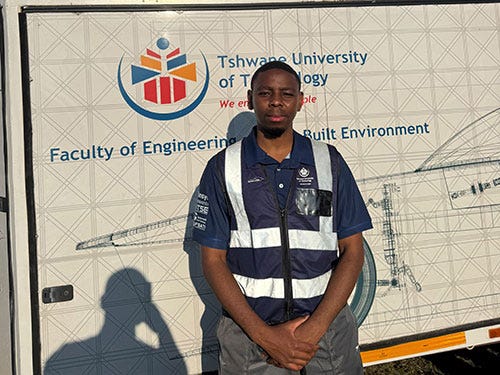
For Katleho Mosoeu, a third-year Mechatronics Engineering student, the journey carried another significance. She was the only female student on the SunChaser 4 team.
Mosoeu worked on the mechanical side of the vehicle, assisting with the braking system, suspension, steering wheel and wheel covers designed to reduce drag. She also served on the mechanical lead team and as a battery safety officer.
Working on SunChaser taught her that engineering does not always follow a perfectly drawn line from problem to solution.
“I learned that engineering is not always about having a perfect solution. Sometimes you must make quick, practical decisions and adapt to what is happening in front of you,” she said.
Being the only female student also strengthened her confidence in her place within engineering.
“Being the only female student on the team was a meaningful experience. It pushed me to become more confident in my abilities and reminded me that I belong in spaces where engineering is happening at the highest level,” Mosoeu said.
She said winning made that feeling even stronger.
“It made me see my place in engineering with more confidence and made me even more determined to continue pursuing the areas of engineering I am passionate about,” she said.
For Bonolo Motsepe, a Mechanical Engineering graduate completing his BEngTech Honours in Mechanical Engineering, the victory marked another chapter in a journey that began in 2023, when he joined SunChaser as a second-year student.
His work has centred on the design, manufacture and assembly of the braking system. During the challenge, he supported mechanical inspections, repairs and adjustments, served as a lead vehicle driver, and mentored newer team members.
His experience was put to the test on Day 3 when drivers reported that the brakes were not clamping as expected, particularly on downhill sections.
“It was a stressful situation because the brakes were a critical safety system, while the wheel covers and steering also needed attention that night,” he said.
The team worked late into the night to investigate the problem and prepare the car for the following day.
For Motsepe, that moment captured one of SunChaser’s biggest lessons: engineering is not only about designing a solution but also about taking responsibility for ensuring it works safely and reliably in practice.
His journey with the team had already included the setback of the car flipping in 2024. Returning two years later and winning the Challenger Class made the achievement even more meaningful.
“I was also proud to help put the TUT name back on the map,” he said. “The victory reminded me that consistent effort, learning from setbacks and making small improvements every day can eventually lead to big results,” he said.
©Higher Education Media Services.