


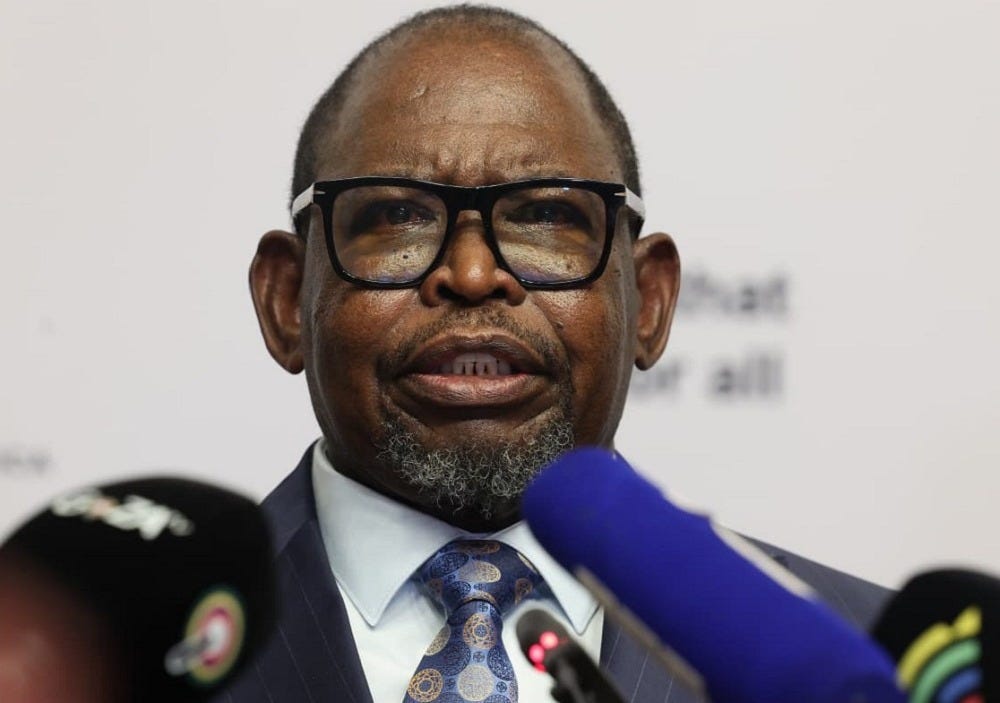
The National Treasury has announced the temporary withholding of July 2026 equitable share transfers to sixty‑nine municipalities across South Africa, citing persistent failures in financial management and governance.
Finance Minister Enoch Godongwana said the decision, taken under Section 216(2) of the Constitution and the Municipal Finance Management Act (MFMA), was “extraordinary but necessary” to protect public money and restore accountability in local government.
“This is not punitive. It is corrective. It is designed to instill fiscal discipline, protect public money, and ensure that municipalities comply with the law,” the Minister said.
Treasury’s figures paint a stark picture. Since 2021–22, municipalities have incurred R24.12 billion in fruitless and wasteful expenditure. Irregular expenditure has reached R145.21 billion, with R40.14 billion recorded in 2024–25 alone. Unauthorised expenditure stands at R118.13 billion, more than half of which was on non‑cash budget items.
Budget credibility has deteriorated sharply: in 2024–25, 116 municipalities - nearly half - adopted unfunded budgets. By year‑end, municipalities owed R3.40 billion in interest to Eskom and R1.21 billion to water boards, while 48 municipalities had overdue third‑party deductions.
“These may sound like administrative matters, but to a household or a business they are deeply personal. They determine whether water flows, whether electricity is supplied, whether salaries are paid, and whether students can continue their studies,” Godongwana said.
Safeguarding Services
Treasury stressed that the withholding of funds is not intended to disrupt essential services. Instead, transfers are being redirected in tranches directly to Eskom, water boards, and statutory bodies to safeguard electricity, water, and pensions. Municipalities that demonstrate compliance will see their transfers reinstated.
Targets have been set: a 15% reduction in irregular expenditure balances by August and another 15% by September, alongside evidence of funded budgets, functioning disciplinary boards, and consequence management.
“South Africans deserve municipalities that are financially sound, accountable, and capable of delivering services. By invoking the Constitution, we are signaling seriousness about governance, fiscal responsibility, and the rule of law,” the Minister said.
Treasury highlighted that despite years of support, guidance, and training, many municipalities continue to adopt unfunded budgets, accumulate unauthorised and irregular expenditure, and fail to meet statutory obligations to Eskom, water boards, SARS, the Auditor‑General, and pension funds.
Godongwana noted that weak governance structures and ineffective Municipal Public Accounts Committees (MPACs) have compounded the crisis. “Non‑payment of service providers results in penalties, interest charges, and service interruptions. Weak governance erodes accountability and public trust,” he said.
Section 32 of the MFMA requires municipalities to recover unauthorised, irregular, fruitless and wasteful expenditure (UIFWE) from those responsible unless certified as irrecoverable by MPACs. Treasury found that many municipalities have failed to process UIFWE cases, undermining consequence management.
“Transfers will resume once municipalities meet the required conditions and submit proof. Compliance will be monitored rigorously. Political and administrative leaders must fulfill their fiduciary duties,” the Minister said.
Corrective Measures
The municipalities affected span all nine provinces, including major metros such as Johannesburg in Gauteng, Nelson Mandela Bay, Buffalo City, and Mangaung. Smaller municipalities such as Makana, Modimolle‑Mookgopong, and Beaufort West are also on the list.
Treasury said municipalities had been given sufficient notice in writing and urged to take measures to change their financial management positions ahead of the withholding of funds. They were also provided a platform to submit reasons why their transfers should not be withheld.
“Our task is to ensure that corrective measures are understood as safeguards, not sanctions. We must demonstrate that fiscal discipline and service delivery can coexist,” Godongwane said.
Godongwana emphasised that restoring the credibility of public finance at both local and national levels is central to South Africa’s growth strategy. “It is about protecting the integrity of our institutions, ensuring that public money serves the public, and restoring trust in local government,” he said.
Treasury will continue to work with municipalities, provincial treasuries, COGTA, and other cooperative governance structures to strengthen financial management. Support will include circulars, one‑on‑one engagements, and training interventions.
“This is not a one‑off intervention. It is part of a broader effort to restore credibility, accountability, and sustainability in local government. Government stands firmly on the side of citizens, protecting their money, their services, and their future,” the Minister concluded.
Municipal Finances at a Glance
Fruitless & wasteful expenditure: R24.12 billion since 2021–22
Irregular expenditure: R145.21 billion, with R40.14 billion in 2024–25 alone
Unauthorised expenditure: R118.13 billion, over half on non‑cash budget items
Unfunded budgets: 116 municipalities adopted unfunded budgets in 2024–25
Debt to Eskom: R3.40 billion in interest owed
Debt to water boards: R1.21 billion in arrears
Third‑party deductions: 48 municipalities overdue
Municipalities affected: 69 across all nine provinces
©Higher Education Media.