


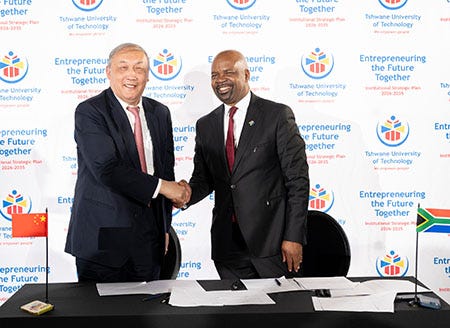
The Tshwane University of Technology (TUT) has signed an agreement with the Chinese International Education Foundation (CIEF) and Beijing University of Posts and Telecommunications (BUPT) to establish Tshwane’s first and only Confucius Institute.
The partnership will promote Chinese language learning, cultural exchange, digital education, research collaboration and skills development, creating new opportunities for TUT students, staff and communities.
The signing of the agreement is a significant step forward in the University’s internationalisation journey and opens a new chapter in educational cooperation between TUT and BUPT.
Speaking at the signing ceremony, Prof Tinyiko Maluleke, TUT’s Vice-Chancellor and Principal, described the occasion as an incredibly important moment in the University’s history.
“I can tell you now that 8 June 2026 will go down as one of the most important days in the 22 years of TUT’s existence. We embrace the historic mission of the Confucius Institute to promote the Chinese language and culture globally, strengthen educational cooperation and enhance international understanding.”
The institute will play a vital role in promoting the teaching and learning of the Chinese language, enhancing an understanding of Chinese culture, strengthening educational and cultural exchanges and supporting local development through skills development and digital education.
“We are especially delighted that the TUT-BUPT Confucius Institute will also focus on a digital and intelligence institute model, which integrates language learning with technology, innovation, research and workforce development,” Prof Maluleke said.
Facilitating a dialogue session during the ceremony, Prof Ben van Wyk, Deputy Vice-Chancellor for Teaching, Learning and Technology, who pioneered the initiative, said the partnership represented far more than the establishment of a language centre. It will also promote research collaboration in ICT, AI, and Communication Technology, creating new opportunities for students, staff, and communities across TUT’s campuses.
“What we are discussing today, marks the beginning of one of the most strategically important international partnerships in the history of TUT,” he said.
Prof Van Wyk explained that the institute would serve all TUT campuses through an innovative digital education model and could positively influence more than 65 000 students across Gauteng, Mpumalanga and Limpopo.
He said the partnership with BUPT would strengthen TUT’s capabilities in future-focused fields such as digital education, telecommunications, information and communication technology, artificial intelligence and innovation.
“This is why we see the proposed Confucius Institute not merely as a language centre, but as a platform for educational innovation, digital transformation, research collaboration, skills development and most importantly people-to-people connections between South Africa and the People’s Republic of China.”
Prof Yang Wei, President of the CIEF, welcomed the partnership and highlighted its unique character.
“This is the eight Confucius Institute in South Africa. In Chinese, eight is a very lucky number. It means prosperity,” he said.
Prof Yang noted that both TUT and BUPT specialise in science and technology, creating an ideal environment for innovation.
“Language tries to bring people together and now we use high-tech telecommunication and new technology to connect the intersections between culture, science, technology and people. This is a unique angle, especially in this AI era.”
Prof Xu Kan, President of BUPT, joined the ceremony virtually and said the institute would support deeper cooperation between the two institutions, while advancing digital transformation in education.
“This achievement reflects the growing partnership between our two universities and demonstrates how China and Africa are working together to advance digital transformation in education and promote mutual learning among civilisations,” he said.
Prof Xu explained that BUPT plans to use the first development cycle of the institute to create an innovative model driven by digital and intelligent technologies.
“We hope to use this first development cycle of the Confucius Institute as an opportunity to build an innovative institute distinguished by digital and intelligent empowerment.”
He added that BUPT intends to develop a digital education centre and an engineering talent development centre in South Africa to create an integrated platform, combining Chinese language learning, digital education and engineering training.
Prof Maluleke said the institute aligned with TUT’s vision of preparing graduates for a rapidly changing world.
“I expect the TUT-BUPT CI to be a hub of planning and language learning aligned with 4IR. Through our technology focus, the two universities will really revolutionise the Confucius Institute model, take it to the next level, and that a few years from now, a student from one of our TUT campuses will be able to address a crowd like this in fluent Mandarin,” he said.
Fan Ding, Education Counsellor at the Embassy of the People’s Republic of China in South Africa, said the new institute had the potential to become a leading Confucius Institute in Africa.
“We will do our best to support our newest Confucius Institute and to turn our shared dream into reality,” he said.
The ceremony concluded with the formal signing of the agreement, a celebratory toast, a word of thanks by Prof Mashupye Maserumule, the Executive Dean of Humanities, and a performance by students from TUT’s Faculty of Arts and Design.
The newly established Confucius Institute at TUT is expected to strengthen educational cooperation between South Africa and China, while expanding opportunities for language learning, digital skills development, research collaboration and cultural exchange for years to come.
©Higher Education Media Services.