


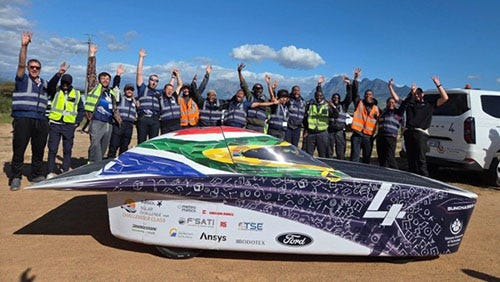
The local team crossed the finish line first in the eight-day race from Sasolburg to Franschhoek this month, ahead of overseas competitors Solar Energy Racers from Switzerland and Team AgniRath from India.
The TUT student engineering team was backed by engineers from the Ford Motor Company of Southern Africa (FMCSA), who worked alongside the students to provide technical mentorship and practical engineering support as the SunChaser 4 navigated its way from the Free State to the Western Cape.
In the Sasol Solar Challenge, the winning team is crowned based on distance, not speed.
The ultimate champion is the team that manages to accumulate the most total kilometres on their solar car over the eight-day event.
TUT was crowned this year’s winner after the SunChaser 4 completed a distance of 2 369.2 km.
Each day, teams must navigate a mandatory base route of roughly 250 to 300 km on public roads.
To clock extra distance, teams can choose to drive optional loops during the day before the daily window closes, provided they have enough solar energy and battery charge left.
If a car breaks down or runs out of power and has to be put on a trailer to reach the next stop, the towed distance is excluded from their official count.
In order to win, the SunChaser 4’s team of student engineers had to make real-time decisions around energy consumption, battery temperatures, vehicle reliability and changing weather conditions.
From strong headwinds and cooler conditions during the opening leg from Sasolburg to Swartruggens, to rising temperatures across the North West, intermittent cloud cover and crosswinds en route to Kimberley, as well as the intense heat and the long open roads of the Northern Cape, each stage brought a different technical challenge.
The students relied on telemetry data to continuously adjust cruising speeds and energy consumption.
Battery cooling cycles were extended during periods of intense heat, solar arrays were cleaned to maximise PV efficiency, while suspension, tyre pressure and wheel alignment checks helped the team respond to rougher road surfaces.
Ford’s involvement extended beyond mentorship. During the journey, the company’s engineers helped 3D print and install components on the solar vehicle, provided roadside diagnostic support when a lighting issue arose on the team’s trailer, and made Ford’s mobile workshop and tools available to assist with repairs.
“Every day presented us with a different problem to solve, whether it was managing energy, responding to changing weather or making technical adjustments on the road,” says SunChaser 4 driver and BEngTech mechanical engineering graduate Mpho Mogadimo.
“We have been able to take what we learn in the classroom and test it in a real-world environment, where every decision has an immediate impact. To come away with the win makes that experience even more special.”
FMCSA says the challenge provided the car maker with a practical platform to work directly with emerging South African engineering talent, allowing experienced automotive engineers to share technical expertise while giving students space to make decisions and solve problems themselves.
“What has stood out throughout this journey is the students’ ability to think on their feet,” says FMCSA engineering and operations leader Marko Venter.
“Engineering in the real world does not always happen under controlled conditions. You have weather, road conditions, time pressures and unexpected technical challenges, and you need to find solutions quickly.
“Our role has been to bring our engineering experience to the table and support them where needed, but the students have been the ones doing the thinking, learning and problem-solving.”
©Higher Education Media Services.