


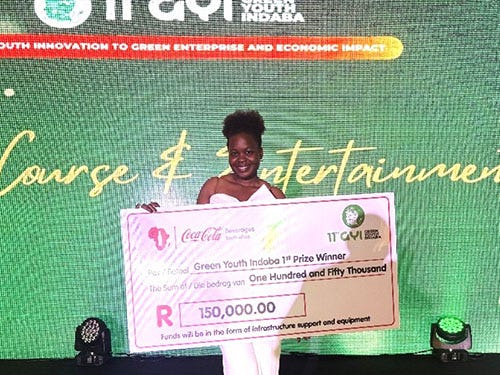
Onndinadaho Rasilwela, a member of the Tshwane University of Technology (TUT) Student Women Economic Empowerment Programme’s (SWEEP) bioplastic innovation has won first prize at the 2026 Green Youth Indaba, taking home R150 000 in cash for a project that transforms sugarcane bagasse and maize stalk into biodegradable mulching plastic. This innovation could change the face of sustainable agriculture in South Africa.
The win was announced during the Green Youth Indaba, one of South Africa’s premier annual environmental summits, hosted at Sun City, North-West, from 17 to 19 June 2026.
Young innovators, entrepreneurs and changemakers from across the country attending the summit are afforded opportunities to connect with climate-action networks, green career pathways and prospects in sustainable development.
The platform proved to be the perfect stage for Rasilwela to showcase years of academic dedication translated into real-world environmental impact.
Rasilwela, who holds an Honours degree in Chemical Engineering and currently is a Research Assistant in the Department of Pharmaceutical Sciences at TUT, impressed judges with a project titled “Comparative Synthesis and Analysis of Bioplastic from Hemp and Maize Stalk.”
At the heart of her research lies a simple but powerful idea: agricultural waste that would otherwise be discarded — particularly sugarcane bagasse and maize stalk — can be repurposed into a fully biodegradable plastic alternative. Rasilwela has branded her innovation “Biomulchies,” a bioplastic engineered for use as an agricultural mulch.
Traditional plastic mulch, widely used by farmers to suppress weeds, retain soil moisture and regulate soil temperature, is a major contributor to long-term soil and environmental degradation due to its non-biodegradable nature.
Biomulchies offers farmers a sustainable alternative that performs the same agronomic function while breaking down naturally in the soil, reducing plastic pollution and supporting circular economy principles within the agricultural sector.
By comparing the synthesis and performance of bioplastics derived from hemp and maize stalks, Rasilwela’s research provides valuable insight into which agricultural by-products yield the most effective and scalable bioplastic solutions — a critical step toward commercialising the innovation for widespread use.
Recognising green innovation
The Green Youth Indaba Innovators Pitch is designed to identify and reward young South Africans who are developing practical solutions to environmental and climate challenges. The national platform that is dedicated to empowering youth participation in the green economy, connects emerging innovators with mentorship, funding and networks that can help take early-stage ideas to market.
Rasilwela’s first-place finish places her among a growing cohort of young South African innovators using science to address pressing environmental concerns, from plastic pollution to sustainable farming practices, while also opening doors to further investment and development opportunities for her project.
Her achievement is also a proud moment for SWEEP, a TUT initiative aimed at equipping young women with the skills, mentorship and entrepreneurial grounding needed to thrive in high-growth sectors such as STEM, innovation and the green economy. Her success highlights the impact of structured support programmes in helping female students translate academic research into innovations with tangible commercial and environmental value.
It is also a strong endorsement of TUT’s broader research and innovation ecosystem, which produces graduates and researchers capable of addressing national and global priorities, including climate change, sustainable resource use and the transition to a greener economy. Rasilwela’s journey from Honours graduate to award-winning innovator reflects the University’s commitment to entrepreneurial, solutions-driven research that empowers people and the planet alike.
As Biomulchies moves toward further development and potential commercialisation, Rasilwela’s win is a personal triumph and an inspiring example for fellow students of what is possible when scientific curiosity is paired with a passion for sustainability.
©Higher Education Media Services.