


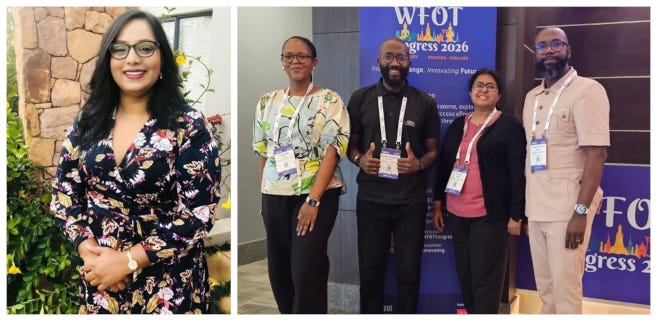
Academics from the University of KwaZulu-Natal’s (UKZN) Occupational Therapy Department made a significant impact at the 19th World Federation of Occupational Therapists (WFOT) Congress, at the Bangkok International Trade and Exhibition Centre.
The event, held in February was themed: ‘Inspiring Change, Innovating Futures’, attracted thousands of occupational therapists, researchers, educators and policymakers from all over the world to discuss innovative approaches to health, participation and inclusion amid complex global challenges.
The UKZN team delivered a series of oral and e-poster presentations featuring South African-contextualised research. Their work aligned closely with WFOT’s emphasis on occupation-centred practice and systems-level transformation, focusing on two key priorities: bolstering health systems for sustained recovery and enhancing economic participation for people with disabilities.
Academic Leader of Research in UKZN’s School of Health Sciences Professor Pragashnie Govender is a longstanding contributor to WFOT, having reviewed abstracts for the past four congresses.
Govender, who chaired three sessions, represented South Africa on the Scientific Committee during a prior host year. At the 2026 event, she co-authored two presented papers.
Head of Occupational Therapy at UKZN Dr December Mpanza, who presented qualitative research highlighting the fragmented state of aftercare services for people with substance use disorders in South Africa.
Mpanza’s multi-phase study called for a comprehensive, lifelong, recovery-oriented model integrated into the broader treatment system, better coordinated and responsive to users and families.
Luther Lebogang Monareng shared his doctoral research introducing the Occupational Therapy Evidence-Based Framework on Self-employment for Persons with Disabilities (OTeSP).
Developed through a scoping review, qualitative methods and Delphi consensus, the framework – rooted in empowerment and systems theories – positions individuals as active agents in their economic empowerment. It guides occupational therapists in facilitating inclusion across micro, meso, and macro levels for improved well-being.
Monareng also presented a complementary poster on systematically selecting and analysing microenterprises as vocational options, stressing considerations such as accessibility, funding, legal factors and individual strengths.
Former Head of Occupational Therapy at UKZN Professor Deshini Naidoo, who has also been a longstanding contributor to WFOT, having reviewed abstracts for the past four congresses, chaired three sessions and presented two studies.
One developed updated, evidence-informed standards of practice for South African occupational therapists through a mixed-methods approach involving international literature reviews, a national practitioner survey, and provincial focus groups/interviews.
The second examined community reintegration challenges for stroke survivors in Limpopo’s Molemole municipality, revealing major disruptions in work and social participation, with less impact on basic daily activities.
Dr Nonjabulo Ndaba presented two studies addressing pandemic-era adaptations. The first analysed COVID-19’s effects on occupational therapy education in South Africa, leading to two proposed frameworks: one for flexible, student-centred online learning to support performance, and another for disaster-responsive education tailored to local socioeconomic and healthcare contexts.
Her second study underscored the need for resources to maintain optimal occupational performance among educators and students during crises, prioritising well-being for sustained engagement.
These contributions collectively illustrated occupational therapy’s power to bridge systemic gaps, drive innovation and deliver inclusive, occupation-based solutions. By elevating African perspectives on the global stage, the UKZN academics reinforced the profession’s essential role in building healthier, more equitable futures.
This story was first published on UKZN News Website.
©Higher Education Media Services.