


By Anita Michel and Annelize Jonker
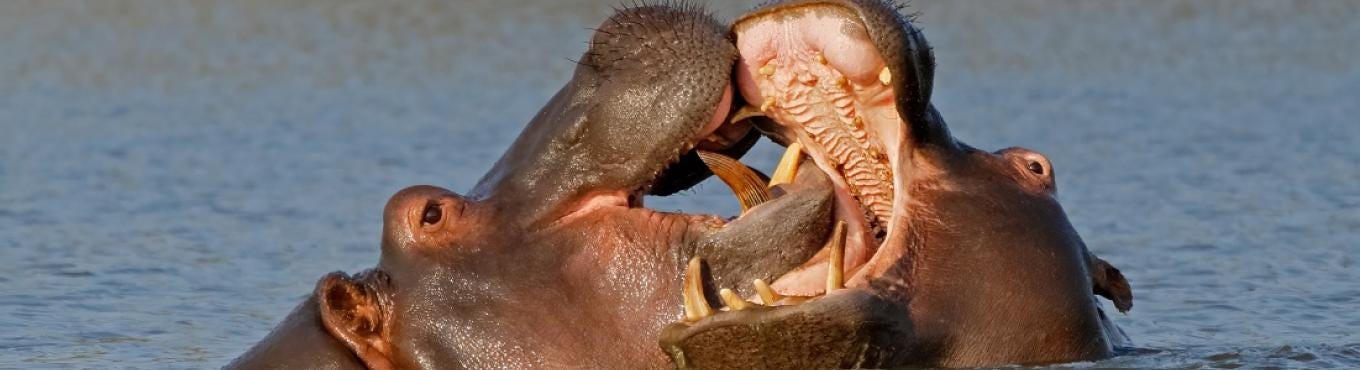
Hippopotami are known to be unpredictable and dangerous. While their bites are infrequent, they are deadly, partly due to complex bacteria in their mouths that are resistant to commonly prescribed antibiotics.
The calm demeanour of a hippopotamus wading through water, its disproportionately tiny ears just peeking out, has cemented its stereotype as a comical river dweller. Yet its reputation among local communities tells a darker, more sobering tale.
Unlike crocodiles, which are feared for their stealth and aquatic ambushes, hippopotami (Hippopotamus amphibius) present a dual threat – they are equally dangerous on land and in water. With their powerful jaws and long, razor-sharp canine teeth, they are capable of inflicting grievous wounds. For those who survive an attack, however, the danger doesn’t end with the bite.
Until recently, little was known about the bacteria that live in the mouths of these formidable creatures. But a groundbreaking, novel study led by Professor Anita Michel of the Faculty of Veterinary Science at the University of Pretoria (UP) has illuminated a new layer of risk.
“We knew the injuries were extraordinary, especially with the exceptional biting force hippos possess,” she explains, “but we didn’t fully understand the link between the microbes and the severe complications from wound infections that clinicians have to deal with.”
Prof Michel and her team – which included UP veterinary specialist bacteriologist Dr Annelize Jonker and Francois Roux, an ecologist from the Mpumalanga Tourism and Parks Agency – examined the oral bacteria of 34 healthy hippopotami captured during routine wildlife operations in the Mpumalanga province. What they discovered was a complex bacterial community: 41 different species, many of them typically found in aquatic environments and capable of causing opportunistic infections in humans.
“This was the first time that anyone has systematically studied the bacterial flora of hippos’ mouths,” Prof Michel says. “And what we found was concerning – not just the types of bacteria, but their resistance to some of the most commonly used antibiotics.”
The team tested the bacteria against a panel of antibiotic drugs and found moderate to high resistance to commonly prescribed treatments like amoxicillin/clavulanate and early-generation cephalosporins. These are staples in emergency medicine, especially for bite wounds from dogs and cats.
But as Prof Michel points out, “using these standard antibiotics for a hippo bite may delay effective treatment and allow infections to take hold”. Conversely, the study revealed that antibiotics from the tetracycline, aminoglycoside and quinolone families were more effective, offering a potential lifeline in future cases. Yet even with these options, time remains a critical factor. The researchers strongly recommend that wound cultures be taken as early as possible to identify the exact pathogens involved to ensure the best outcome for the patient admitted to a hospital.
“It is critically important that wound infections, whether in animals or humans, are treated early with an effective antibiotic regimen aligned with the expected causative infectious agents,” Prof Michel says.
The implications of this study extend beyond individual injuries. It offers a stark reminder that antibiotic resistance is not just a clinical or hospital issue; it is a wildlife issue too, shaped by ecosystems, species interactions and the limits of human preparedness.
“Our goal is to take a One Health approach with healthcare providers in regions where humans and wildlife intersect to ensure that they are not caught off guard,” Prof Michel says. “When you’re dealing with a hippo bite, minutes matter – and so does the right antibiotic.”
Why this research matters
The common hippopotamus occurs in rivers, lakes and wetlands in sub-Saharan Africa, and is known for its aggressive behaviour when defending its territory and its young. Their bites can be deadly – they kill about 500 people in Africa each year, more than twice the body count for lions. This groundbreaking study underscores the need for early treatment of bite wounds and highlights which antibiotics are most effective.
Fast Facts
A hippopotamus’s bite force is about 8 100 Newtons, roughly the weight of a large grand piano or a small car.
Hippopotami are one of the world’s deadliest mammals, even more deadly than a lion or bear.
The word “hippopotamus” is Greek for “river horse”.
41 different species of bacteria are found in a hippopotamus’s mouth.
A hippopotamus’s mouth is 0.6m wide but 1.5m wide when fully open.
They have 36 teeth that are 40cm long for incisors and 50cm or more for canines
Professor Anita Michel of the Faculty of Veterinary Science and UP veterinary specialist bacteriologist Dr Annelize Jonker wrote this article.
© Higher Education Media Services