


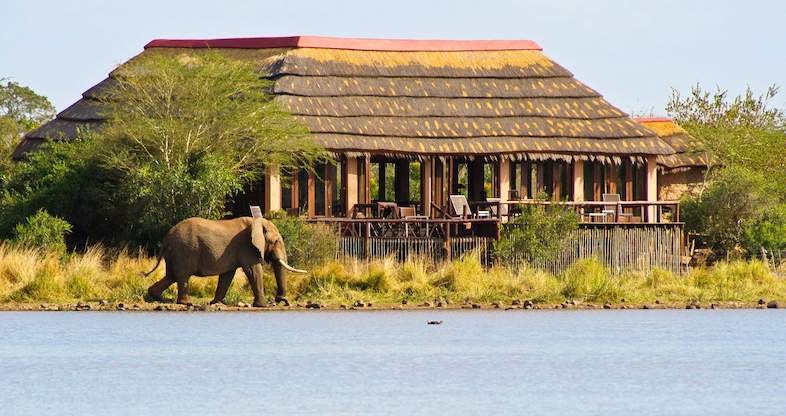
A new international study co-authored by a University of Pretoria (UP) conservation scientist is pushing back against one of the most widely cited claims in global environmental debates – that wildlife populations have declined by more than 70% over the past half century.
Drawing on detailed data from sub-Saharan Africa, the researchers argue that the narrative of uniform, catastrophic biodiversity collapse does not hold up on the ground – and may even undermine effective conservation.
Published in the leading scientific journal Science Advances, the paper examines long-term wildlife population data from across Africa and finds that many wildlife populations often portrayed as emblematic of global decline are in fact stable or increasing where they are properly protected and managed.
Referring to the headline claim of a roughly 70% global wildlife decline, the study’s lead author, Stuart L. Pimm, Extraordinary Professor at UP’s Conservation Ecology Research Unit (CERU) and Doris Duke Professor of Conservation at the Nicholas School of the Environment at Duke University in North Carolina, USA, said, “It’s not even remotely true.
For example, in the (Worldwide Fund for Nature’s) Living Planet Report 2024 the graph showing the supposed year-by-year inexorable decline in wildlife uses a little elephant as the symbol to plot the data.
In fact, Southern Africa – by which we mean the middle of Tanzania southwards – holds 75% of savannah elephants and they are slightly more numerous than they were 25 years ago. This was shown by a major paper from CERU a year ago.”
Prof Pimm added that the debate in southern Africa is increasingly about managing abundance, not preventing extinction. “As we all know, the problem we face in this area is that some think we have too many elephants. Kruger (National Park) may consider culling them, those in Addo (Elephant Park) are on contraceptives, and for those in Botswana, there was the threat to ship thousands of them to Germany in protest over that country’s complaints about hunting.”
Rethinking ‘malicious’ claims
He describes claims about large-scale global wildlife population decline – especially those concerning sub-Saharan Africa – as “malicious”.
“They overlook substantial conservation success stories, including that of the black wildebeest, which South Africans brought back from near extinction. So, what these claims do is to impugn the striking successes that South Africa and its neighbours have achieved to protect biodiversity. The claims are deeply offensive.”
The new study uses Africa as a stress test for global claims of ecological tipping points and irreversible collapse. If biodiversity were collapsing everywhere, the authors argue, it should be especially evident in sub-Saharan Africa – a region where the human population has more than tripled since the 1970s, and where poverty and land-use pressures are acute.
“If there was a place where biodiversity ‘should’ collapse, it would be here. The human population has increased 3.5 times in 50 years, and many areas are among the poorest on the planet.” His extensive experience in the region meant he was not surprised by the research results. “But others should be,” he said.
A closer look at the numbers
The researchers re-analysed wildlife population time series data, arguing that widely cited global indices can be distorted by short or statistically weak datasets. When longer, more robust datasets are examined, they say, the picture is more nuanced: some species are in serious decline, particularly where poaching and habitat loss remain intense, but others are stable or recovering under active conservation management.
He and his colleagues argue that dramatic global narratives overstating biodiversity decline undermine public trust and can hamper practical conservation work.
“The challenges we face at CERU are difficult. Having large, non-Africa based groups telling the world that Africa has made a mess of things undermines trust, when it’s much more complicated than that. We are doing some things very well. We must tackle tough problems, make mistakes, and celebrate success.”
The paper forms part of a broader body of work examining how biodiversity is measured under the Kunming-Montreal Global Biodiversity Framework. The authors argue that conservation science must shift from broad, sometimes alarmist narratives to measurable, evidence-based outcomes.
In a related paper published recently in the journal Proceedings of the National Academy of Sciences (PNAS), Professor Pimm and co-author Professor John Gittleman, founding Dean of the Odum School of Ecology at the University of Georgia, USA, argued that the valuable lessons from conservation science must be applied more rigorously under the global framework. “Progress – and failures – should be tested against clearly defined targets,” Prof Gittleman urged.
CERU Director Dr Bernard Coetzee, who was not involved in the study, welcomed the findings. “I welcome research that advances evidence-based conservation metrics, which is sorely needed globally, but especially so in Africa,” he said, adding that CERU is committed to strengthening conservation science capacity in Africa and contributing to global biodiversity policy debates.
The real lesson
According to Prof Pimm, the real lesson from the African data is not complacency but clarity.
“We need to be smart in protecting more areas, connecting populations where possible, avoiding having animals in small areas behind fences. None of those options is easy, but explaining the problems and getting support for their solutions is the way forward. Let’s celebrate our successes.”
As governments and conservation organisations move to implement global biodiversity targets, the study serves as a reminder that how decline is measured – and how it is communicated – may shape not only public perception, but the future of conservation itself.
The study was first published in University of Pretoria website on 24 March 2026.
©Higher Education Media Services.