


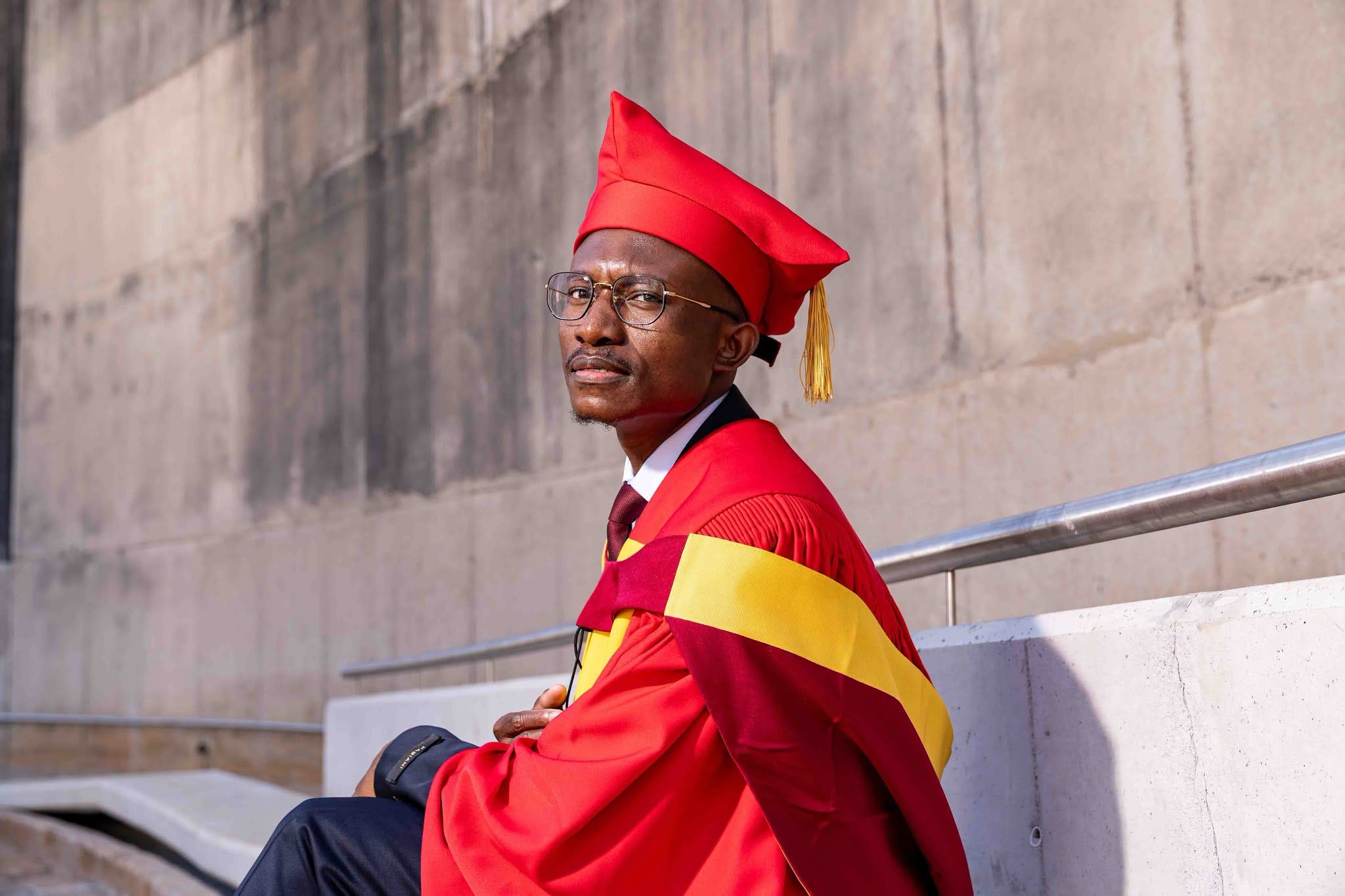
New University of Pretoria (UP) PhD graduate Matome Edwin Matsepe’s research could help reshape how learners engage with mathematics in South African classrooms.
Matsepe graduated with a PhD in Mathematics Education during UP’s Spring Graduation ceremonies, held from 31 August to 4 September 2026. His doctoral research, titled ‘Reasoning-and-Proof Opportunities in Euclidean Geometry in Grade 10–12 Mathematics Textbooks’, examined 1 972 tasks across nine South African mathematics textbooks to understand the kinds of mathematical thinking they encourage.
Matsepe’s interest in mathematical reasoning and proof developed throughout his journey from learner to mathematics teacher, head of department, and now Mathematics Education lecturer. His interest began with his own experiences as a learner, when he found it difficult to learn mathematics by simply applying procedures and formulae without understanding why they worked. This made mathematics challenging for him, and, at the time, he was regarded as one of the learners who struggled with the subject.
These experiences sparked a deeper interest in understanding the reasoning behind mathematical ideas and, over time, shaped his view that learning mathematics is not only about knowing what to do but also about understanding why it works.
As a teacher, he began looking from one textbook to another for tasks that could help learners explain their thinking, make connections and understand the logic behind mathematical ideas. His PhD allowed him to move beyond this intuitive search for “good tasks” and develop a systematic understanding of how textbook tasks can create opportunities for learners to reason, engage with proof and develop a deeper understanding of mathematics.
“At its simplest, mathematical reasoning is about thinking through mathematics,” Matsepe said. “It involves noticing relationships, making connections, identifying patterns, using intuition, making conjectures, giving reasons and deciding whether an argument makes sense.”
His research found that South African mathematics textbooks provide considerable opportunities for reasoning and proof, but that these opportunities are largely concentrated around formal proof and imitative forms of reasoning. Learners are often asked to apply established procedures, reproduce known reasoning or work with geometric theorems that have already been established.
Learners have comparatively fewer opportunities to explore mathematical relationships, make conjectures, evaluate arguments, identify errors, and develop more creative forms of reasoning.
For Matsepe, this distinction matters because a proof question does not automatically mean learners have been given a rich opportunity to develop mathematical reasoning.
His research proposes a framework that provides a systematic way of asking what kind of mathematical thinking a task makes possible, and could help textbook developers design a progression of tasks from exploring and making sense of mathematical ideas to constructing formal proofs. “The aim is not to eliminate routine mathematical practice,” Matsepe said. “Routine tasks have their place. The aim is to ensure that they are complemented by tasks that require learners to think, connect ideas, explain, justify and reason.”
The findings also have implications for education policy and the development and quality assurance of curriculum resources. Matsepe said the framework and findings could potentially complement existing processes used by the Department of Basic Education to evaluate and approve textbooks by providing an additional lens through which the quality of mathematical tasks can be considered.
Rather than focusing only on whether textbooks cover the required curriculum content, such an approach could also consider whether the tasks give learners meaningful opportunities to reason, make connections, justify ideas, and develop mathematical understanding. This could support the development of textbooks and other curriculum resources that align not only with what learners are expected to know but with how they are expected to think mathematically.
The framework also has implications for teacher education. As a mathematics education lecturer, Matsepe sees the need to help pre-service teachers recognise and design tasks that facilitate mathematical reasoning. He intends to use the findings and framework from his study to strengthen future teachers’ pedagogical judgement about task selection and design.
The research is particularly relevant to South Africa, where textbooks remain an important teaching and learning resource, especially in rural and under-resourced schools. Matsepe said the quality of textbook tasks is therefore an issue of educational opportunity and equity. “If a textbook is one of the main resources available to a learner, it should provide opportunities not only to practise procedures but also to think deeply about mathematics,” he said.
His doctoral journey also took his research beyond South Africa. He presented his findings in Australia and France, while his supervisor, Prof Ugorji Ogbonnaya, presented the research in Finland, allowing research grounded in a South African context to contribute to wider conversations about mathematics textbooks and task design.
“Presenting my research findings in Australia and France, and seeing my supervisor present the work in Finland, has been one of the highlights of my doctoral journey,” he said.
As a Mathematics Education lecturer, his PhD studies have given him valuable experience in academic writing, supervision, collaboration and engaging with the broader scholarly community. He said his supervisor helped him understand that a PhD is developed through a community of practice – through writing manuscripts, presenting ideas at conferences, submitting work to journals and engaging with feedback from other scholars.
He credits Prof Ogbonnaya’s belief in him and in the study as an important source of strength throughout the doctoral journey. “Prof Ugorji Ogbonnaya believed in me and believed in the study, even during the difficult times. That belief carried me through some of the most difficult moments of the PhD,” Matsepe said.
For Matsepe, graduating from UP represents more than earning a qualification. He described completing his PhD as a test of character that taught him patience, perseverance – and the importance of trusting the process. “Graduating is therefore not only about earning a qualification; it is a reminder of what is possible when one remains committed to a goal despite the challenges along the way.”
©Higher Education Media Services.