


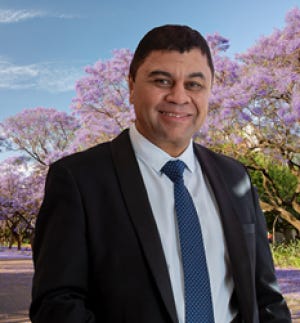
Professor Francis Petersen, Vice-Chancellor and Principal of the University of Pretoria (UP), has been elected to the administrative board of the International Association of Universities (IAU) for a four-year term.
The IAU is a global voice for higher education. Headquartered in Paris, France, it has more than 600 member universities across 120 countries.
The elections took place at the IAU’s 17th General Conference, hosted by Murdoch University in Perth, Australia, where member institutions and organisations from around the world gathered to set the strategic direction for the next four years, known as Strategy 2030.
The strategy’s key focus areas include sustainable development, digital transformation, and leadership development in higher education to address the complex and challenging global environment.
“I’m honoured to have been elected to the IAU board, and I will make the most of the opportunity and responsibility to foreground South Africa and the continent’s voice as part of global higher education’s voice,” Prof Petersen said.
His election gives UP a distinctive seat on the IAU board, joining four other heads of African universities from Ghana, Ethiopia, Kenya, and Zimbabwe. Additionally, the board’s President is an alumnus of Witwatersrand University, Prof Patrick Deane, Vice-Chancellor of Queen’s University in Canada.
Universities must remain democratic and independent to produce insightful, innovative, creative graduates with strong analytical, research, and critical thinking skills, combined with character, conscience, and responsibility.
“Higher education is a microcosm of society, and we are faced with huge socio-economic and political uncertainty worldwide,” Prof Petersen said. “But at the same time, this offers vast potential for a reset where we can reshape our future and address society’s shared complex challenges.
“Globally, we need to transform how higher education institutions present themselves and what they offer. We need to be recognised and appreciated as a key resource and asset in addressing complex challenges.”
Intrinsic to this is that higher education leadership needs to develop what Prof Petersen calls “knowledge diplomacy”.
“We need to be discreet in navigating the political scenario, but we also need to be bold in getting through to the leadership and decision-making spaces – the political, parliamentary, policy, and legislation power bases, as well as banking, business, industry, NGO, and civil society leadership spheres.
“These are our stakeholders, and we have to leverage economies of scale to bring the importance of higher education into the public domain, into the government, business, the economy, and our communities.”
Prof Petersen added that higher education’s impact must be experienced as transformative throughout society.
“To name a few areas, we need to protect the natural environment and ecosystems that sustain us. We also need to address employment and the requirements of the future world of work, and ethically and responsibly leverage the advantages of the artificial intelligence era – not as a replacement for people and skills, but as an aid to greater efficiency, knowledge, and innovation.
“Additionally, we need to combine disciplinary skills with multisectoral collaboration in a borderless knowledge environment, aligned to the Sustainable Development Goals. Over the next four years, I am confident the IAU will go a long way towards achieving all this and more, as part of Strategy 2030. I look forward to playing my part.”
©Higher Education Media Services.