


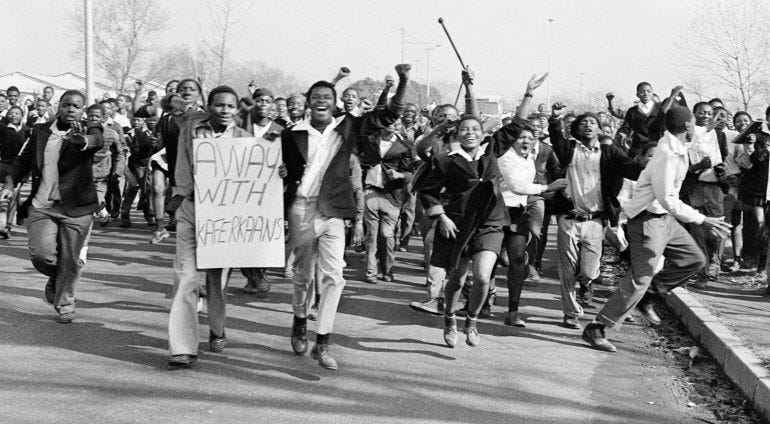
After the very first ballot of 1994, some of us, who were in the class of ‘76 felt betrayed. My disappointment and frustration was expressed in a series of columns since1996 especially around basic services such as education, social grants, health, safety and security. I was labelled a ‘counter-revolutionary’ and a ‘silly affirmative action appointee’.
I was bitter because after 1994, my children were still forced to learn Afrikaans when my generation still had fresh scars from the wounds we sustained for rejecting the language as a medium of instruction. The turn of events was a shock to my system.
When one considers we buried our classmates for protesting against Afrikaans - the language of our oppressors - that I would be upset that my children had to learn the language was not insignificant by any measure. For me that was the state telling us our dead were wrong and had spilled their blood for nothing.
Today’s ruling class, many of them from my ‘76 generation, got into government and made Afrikaans compulsory. Our languages - isiZulu, Sesotho, isiXhosa, the languages of the majority - were made optional in public schools. You had to go broke for your children not to be forced to learn the language by enrolling them in private schools
We had to get into debt to save our children from township schools. We woke them at 4am. We packed them into minibus taxis and sent them to Coloured, Indian and White schools. Not because we had a choice. The new government would not fix the schools we had burned down to free them and would not put resources into those that survived the turmoil.
We got broke in our quest for a better education, we were now made to carry the burden and the debt of our 1976 struggle against Bantu Education. How ironic. We let a government of the people dumb down the education of our children year-after-year and we didn’t protest because we trusted our own to have our backs.
We clapped when former education minister Angie Motshekga said 30% is a pass when we knew it was a total fail. We called it progress because we were caught up in the frenzy, blinding ourselves to the danger signs around us.
My last-born arrived in the year 2000. By Grade 6, the curriculum had changed about six times. I asked a teacher how he was supposed to keep up and I left without any clear answers. The teacher too was confused.
Now we have graduates who cannot work. They are angry at my generation. Angry at the freedom we celebrated yet they are not enjoying its fruits. We get lumped together with the politicians who sleep in Parliament and fail to change the status quo. Our children say we are selfish, self-serving and an incompetent lot.
And who can blame them? They cannot tell an elder who earned their seat from one who was deployed by the party. The lines are blurred.
On X, one wrote: “Just because the ’76 generation fought to share toilets with whites doesn’t make them heroes.” It stings, to see our struggle reduced to a fight for white privileges. But how do we answer? The youth of 2026 face unemployment, poverty, landlessness. The children in the Eastern Cape suffer from stunted growth because malnutrition is back on the menu.
That is the irony that chokes me. Some of us got lost in the Rainbow Nation and forgot many of our classmates who never made it to 20, let alone 30. Many of those who did became the ‘lost generation’ - traumatised from 1976 throughout the 1980s, and were never allowed to heal before the HIV/Aids Pandemic struck and decimated our communities in the 1990s.
We were traumatised and we were naive. We did not see how the narrative was created to make us worship heroes crowned on our behalf while our true liberators were pushed aside or erased. The media pushed one narrative and the alternative press we relied on died the day its funders supported the new status quo.
Those who were awake and not drowned by the noise saw through the Rainbow Nation extravaganza. We asked why 16 June was part of a spectacle when our youth had been slaughtered on this day. Why were our children bussed to stadiums, put on stage to dance, drink and celebrate on the day we should have been lighting candles, beating drums, reading poems for the dead as we used to do prior to 1994.
In the townships, we used to mourn our fallen heroes including the Sharpeville and 16 June 76 martyrs. Before the Rainbow Nation, we remembered. Then someone decided memory was dangerous and they rewrote our history. Now we know why.
Today we ask why our children drown in alcohol and why drugs own them. Why did the cartels come here to cook poison for our youth, traffic our children, sell them poisonous foods, kidnap and launder money and yet there is no outrage.
Outrage requires memory and the memories of our liberation struggle heroes have been slowly erased.
We spent our energy and resources on other people’s agenda and ended up sowing division among ourselves, re-engineering our society and values. We lifted our daughters through empowerment, mentorship campaigns and gender-based job reservations and forgot our sons. Sons who never beat a woman, never passed a law, never colonised a mind. Yet we punished them for sins they did not commit.
Now our sons are bitter. They are emasculated. And they turn that rage on our daughters and commit suicide on a scale we haven’t experienced before. Thousands of them join marches on the streets and we watch snuggly from our television screens, hoping and praying they don’t come near our neighbourhoods.
Our children want us gone. All of us old ones, out of government, out of the private sector and out of sight. But the knives are sharper for African women, from the same young women we raised to lead, sadly. That hurts. But who can blame them?
But all is not lost. There is a new breed of young women leaders - Jacinta Ngobese-Zuma, Princy Mthombeni, Amani Dube, Dr Nasiphi Moya, Faith Mangope and many more who make us proud for having the courage and integrity to lead and to change the narrative about our history and where we are today.
They carry the spirit of 16 June ’76 and did not swallow the line that 1994 liberated us. Our daughters have woken up. They see what we refused to see that no one is coming to save us.
The struggle for total emancipation is not over. It must go higher now and whispers and threats from above mustn’t deter their mission. The political elite and their comfortable middle class fellow travellers prefer things to stay as they are. They benefit. They are safe and they are used to hearing their own voices on matters that don’t affect them.
Many women of my generation stand behind the young fighters of today and encourage them to move without fear of jail or grave. We accept the fight in 2026 is not the fight we fought.
Today foreign criminals syndicates as Lt General Nhlanhla Mkhwanazi has warned, are colluding with some of our politicians, our police and our courts to turn ours into a lawless state. So they also face real danger.
These very people swore to protect us and yet they are fighting very hard against efforts to rid our streets of crime and grime. They too use apartheid language by threatening imprisonment while discrediting activists with allegations of foreign funding.
Our ‘76 struggle seemed harder because we faced open racism and white supremacists who beat us, shot us and killed us in broad daylight. We knew the enemy’s face.
But your struggle becomes even harder because the enemy has learned from history. He placed faces like yours and mine in front to do his bidding. Now he sits back. He watches us fight each other. He keeps the land, our minerals while we scramble for crumbs.
The young women of 2026, must remember Winnie Madikizela-Mandela. She was called a monster and accused of fanning the flames of violence. But today they name buildings after her and call her Mother of the Nation.
So you too will be vilified in your lifetime although you are leading peaceful marches and lobbying to change sections within the constitutions that don’t serve our interests. But keep pushing knowing that the class of ‘76 is right behind you, maybe not in flesh, but in spirit and in prayer.
As the saying goes: “The brave never die, though they sleep in dust. Their courage serves a thousand living men” and I would add a “thousand living women too”.
Aluta Continua.
©Higher Education Media Services.