


A student leaves university with a degree, but no job. Was the university supposed to have done more? Or is the deeper problem that there are simply too few jobs waiting at the other end?
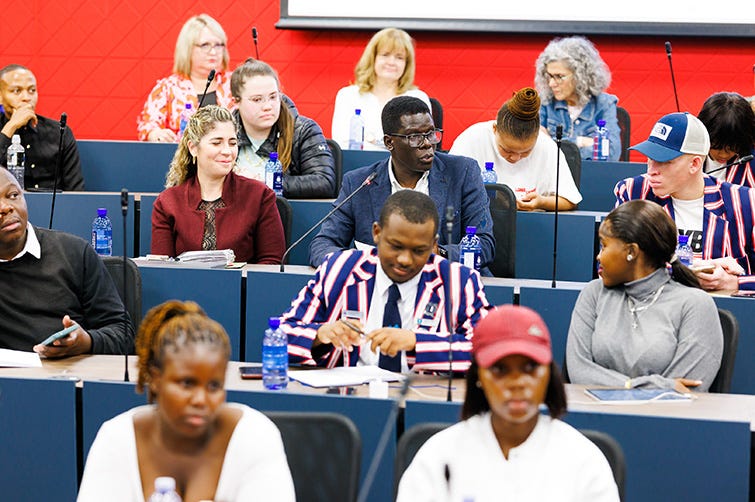
That tension ran through the Faculty of Economic and Management Sciences (EMS) Debate Series at the University of the Free State on 21 September, where students, academics, and industry voices challenged one another over whether the faculty teaching model is keeping pace with the changing world of work.
The motion before the house was: ‘This House Believes That the Faculty of Economic and Management Sciences’ Teaching Model Is Not Preparing Students Adequately for Employment and the World of Work of the 2030s.’
The most revealing questions were about the student sitting in a lecture hall today. South Africa’s unemployment problem gave that discussion its urgency as participants grappled with where the university’s responsibility for graduate employment begins and ends. The challenge is compounded by the fact that students are being prepared for a world of work that does not yet fully exist.
The workplace starts before graduation
For students, the gap between university and the workplace can be difficult to navigate. They are expected to be digitally capable and adaptable, yet access to technology and opportunities to gain practical experience varies.
At the same time, graduates can find themselves competing for jobs that ask for experience they have not yet had the chance to acquire, in an economy that cannot create enough formal-sector jobs for everyone.
Zuleka Jasper, a UFS alumna and chartered accountant who spent three decades in the audit profession and business, put the test bluntly. It is easy to point to policies, curriculum changes, and good intentions. The real test, she argued, is what happens when graduates enter the workplace.
“The proof of the pudding is in the eating,” she said.
For Jasper, that means asking whether graduates can actually apply what they have learned when they encounter the demands of business. She pointed to qualities such as analytical thinking, creativity, emotional intelligence, lifelong learning, and the ability to interrogate information produced by digital tools as skills that employers are already looking for.
But the debate also challenged the assumption that every EMS graduate will enter a conventional corporate job.
Dr Anita Venter, a development practitioner and lecturer in the Centre for Development Support, pushed the faculty to look harder at the economic world that its students actually inhabit.
If the UFS speaks about decolonising its curriculum, she argued, then the informal economy cannot remain outside the frame, particularly when it forms part of the lived reality of many students.
The issue is not simply whether students can be placed in formal-sector jobs. It is whether their education recognises and equips them for the different ways people make a living in South Africa.
The students are already thinking about it
The students in the room brought the discussion down to earth.
For Samkelo Mngomezulu, Chairperson of the Black Management Forum (BMF) Student Chapter at the UFS, who opened the debate in support of the motion, the problem is not simply whether students leave university with enough academic knowledge. It is whether they can use that knowledge when they get their first opportunity.
“Technical knowledge alone is insufficient if graduates cannot execute on day one,” he argued.
Mngomezulu pointed to the growing expectations placed on graduates to bring practical experience, business acumen, and transferable skills into the workplace. He also questioned whether traditional lecture-based teaching is changing quickly enough for a working world increasingly shaped by artificial intelligence, rapid technological change, and complex problems.
Kgothatso Moletsane, Secretary of the EMS Faculty Student Council, challenged the assumption that universities can prepare students by simply identifying the skills that will be needed in 2030.
With the future workplace impossible to predict with certainty, she argued that the answer cannot simply be a list of technologies or skills that students are expected to master.
For Moletsane, the more lasting value lies in what students learn to do when the answer is not obvious: analyse a difficult problem, apply information to an unfamiliar situation, defend an argument, and think independently.
“Sometimes we only recognise what we’ve learned when life asks us to use it,” she said.
Mngomezulu is asking whether students get enough opportunities to apply what they learn before graduation. Moletsane is asking whether the answer can really be found in trying to predict the workplace in the first place.
For students, the challenge is ultimately practical: using what they have learned in a working world that may look very different from the one they expected when they entered university.
Shaping what comes next
For Prof Frans Prinsloo, Deputy Dean: Teaching and Learning in the faculty, the debate’s value lies as much in what it feeds into afterwards as in the arguments raised on the day.
“These discussions will directly inform how we curriculate and shape the faculty’s teaching and learning strategies going forward,” he said.
Prof Prinsloo said work-integrated learning, structured engagement with industry, and the intentional development of graduate attributes will receive renewed focus in the wake of the debate.
“The debate is also extremely helpful in informing our current project to recurriculate our academic programmes, in order to prepare graduates for the world of work of the 2030s and beyond,” he added.
©Higher Education Media Services.