


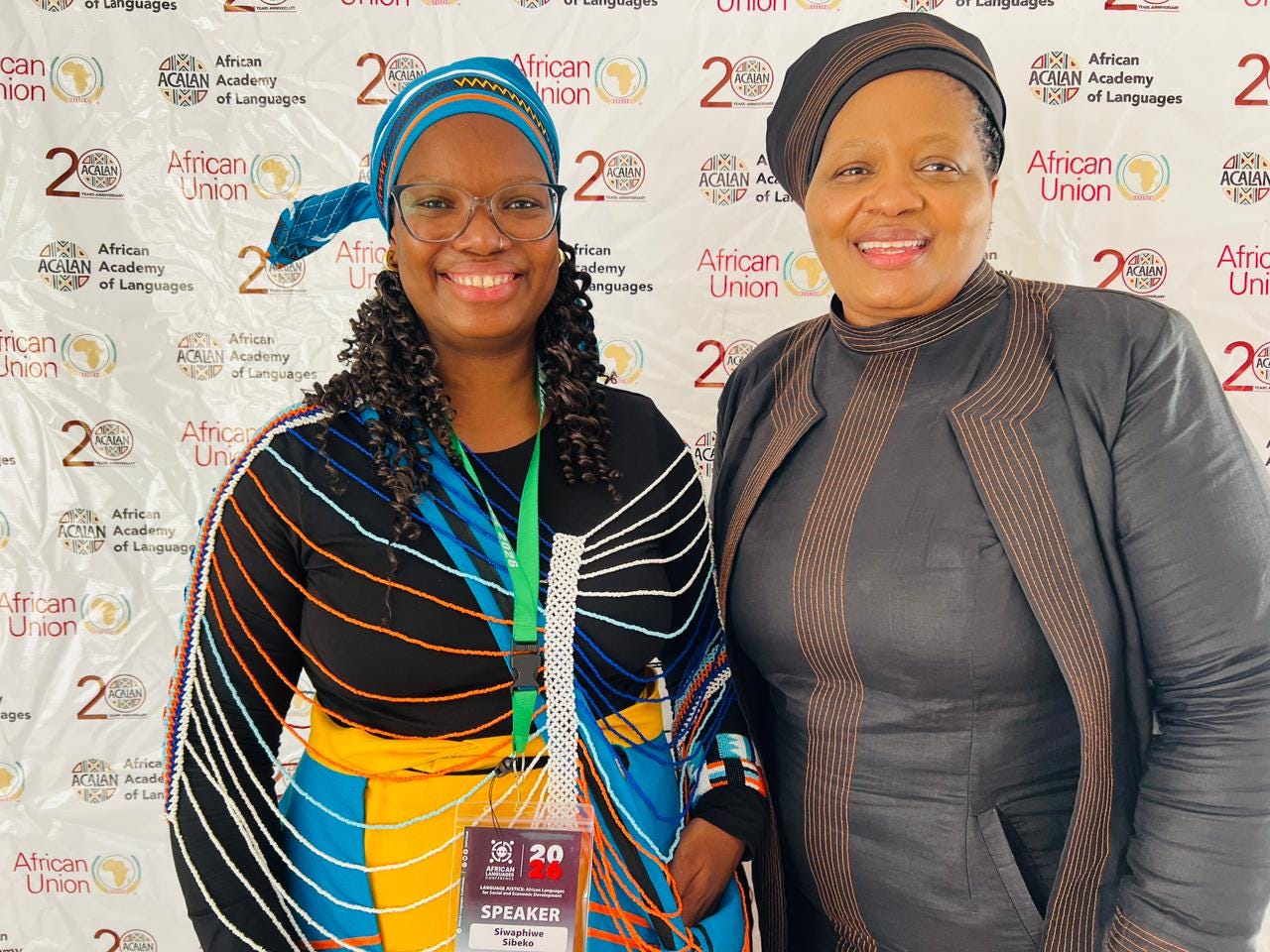
On a stage in Accra, Ghana, a South African educator stands before a continental audience and begins—not in English, not in translation—but in isiXhosa.
It is an intentional choice. And it lands exactly where it is meant to.
This week at the African Languages and Literacies Conference (AFLC), Funda Wande’s Programmes Officer, Siwaphiwe Sibeko, is doing something rarely seen in global education spaces: she is not debating whether mother‑tongue education works. She is demonstrating that it does.
Her session, Language, the Elephant in African Classrooms, Addressed by MTBBE, is delivered entirely in isiXhosa—despite the fact that isiXhosa is not spoken in Ghana. The message is unmistakable: African languages do not require permission, apology, or translation to belong in serious intellectual spaces. They belong here already.
Mother Tongue-based Bilingual Education (MTBBE) is a South African Department of Basic Education programme designed to improve learning outcomes by using a learner’s home language alongside English or Afrikaans.
But this moment carries even greater weight because Sibeko is not standing alone.
Sharing the stage with her is Dr Naledi Mbude‑Mehana, Deputy Director‑General at South Africa’s Department of Basic Education and a pioneer of the country’s Mother Tongue Based Bilingual Education (MTBBE) programme. For Sibeko, Mbude‑Mehana is more than a senior official—she is a career role model. For the audience, the pairing represents something rare: policy and practice, side by side.
Introduced in 2024 and rolled out nationally from 2025, MTBBE marks one of South Africa’s most significant education policy shifts in a generation. From Grade 4, learners are taught in their mother tongue while developing English alongside it—a bilingual model designed to strengthen both languages, rather than sacrificing one for the other.
What Sibeko brings to the conversation is proof that this policy is not aspirational. It is already alive in classrooms.
Funda Wande, the South African non‑profit she represents, has spent nearly a decade building the foundation for this moment. Working across the Eastern Cape, Limpopo, and the Western Cape, the organisation develops bilingual, mother‑tongue‑aligned learning materials and provides structured teacher support in Foundation Phase classrooms. Through its Bala Wande literacy programme, children learn to read and make meaning in isiXhosa, Sepedi, Afrikaans, and English—starting in the language they understand best.
Sibeko’s presentation traces how language policy quietly shapes who succeeds and who is marginalised in African classrooms. It is a story grounded not in theory, but in years of classroom‑level work.
“Language is often the invisible barrier to learning,” she says. “We are proud to see it being placed at the centre of the conversation.”
For Sibeko, the work is deeply personal. Growing up in Namakwê in the Northern Cape, she experienced firsthand what it means to learn through a language that is not your own.
“Language can either limit you or give you access,” she explains. “When a child learns in a language that is not their own, they are not just learning maths—they are learning the language at the same time. That is two burdens on one small person. MTBBE removes that burden.”
As South Africa’s MTBBE rollout gains momentum, Funda Wande’s Foundation Phase work slots into place with striking coherence. Its Bala Wande materials support learning in home languages from Grade R to Grade 3. MTBBE extends that pathway into Grade 4 and beyond—creating, for the first time, a continuous mother‑tongue learning journey through the primary years.
The implications are clear.
The model exists.
The materials exist.
The results exist.
Organisations like Funda Wande have spent years inside classrooms, equipping teachers with the tools and support needed to make mother‑tongue instruction work at scale.
“The elephant in the African classroom is that language is complicated,” Sibeko acknowledges. “It requires planning and evaluation to ensure quality learning materials and faithful implementation. But we are past the point of not talking about it. The research is clear. The results are clear. What we need now is the will to act.”
That call—to government, funders, and education partners—is explicit. What is working now must be resourced, sustained, and protected.
And the significance of this moment stretches far beyond South Africa.
That isiXhosa is spoken on a Ghanaian stage is itself a declaration. It affirms what Funda Wande has long argued: African languages are not parochial tools of local convenience. They are sophisticated vehicles of knowledge, scholarship, and international dialogue. They belong on every stage.
The AFLC gathers researchers, educators, policymakers, and practitioners from across the continent to advance the role of African languages in learning. Funda Wande’s presence in Accra signals that South Africa’s practitioners are not only implementing policy—they are helping shape what mother‑tongue education can look like across Africa.
For Sibeko, the future feels closer than it once did.
“What gives me hope is that we are now having these conversations,” she says. “That we now have policies like MTBBE. Access will now be freedom. An African child who learns in their language can show up fully—at school, at the hospital, in the courtroom, in the boardroom. That is what this work is about.”
On this stage, in this language, the future of learning is no longer being argued for.
It is being spoken into being.
©Higher Education Media Services