



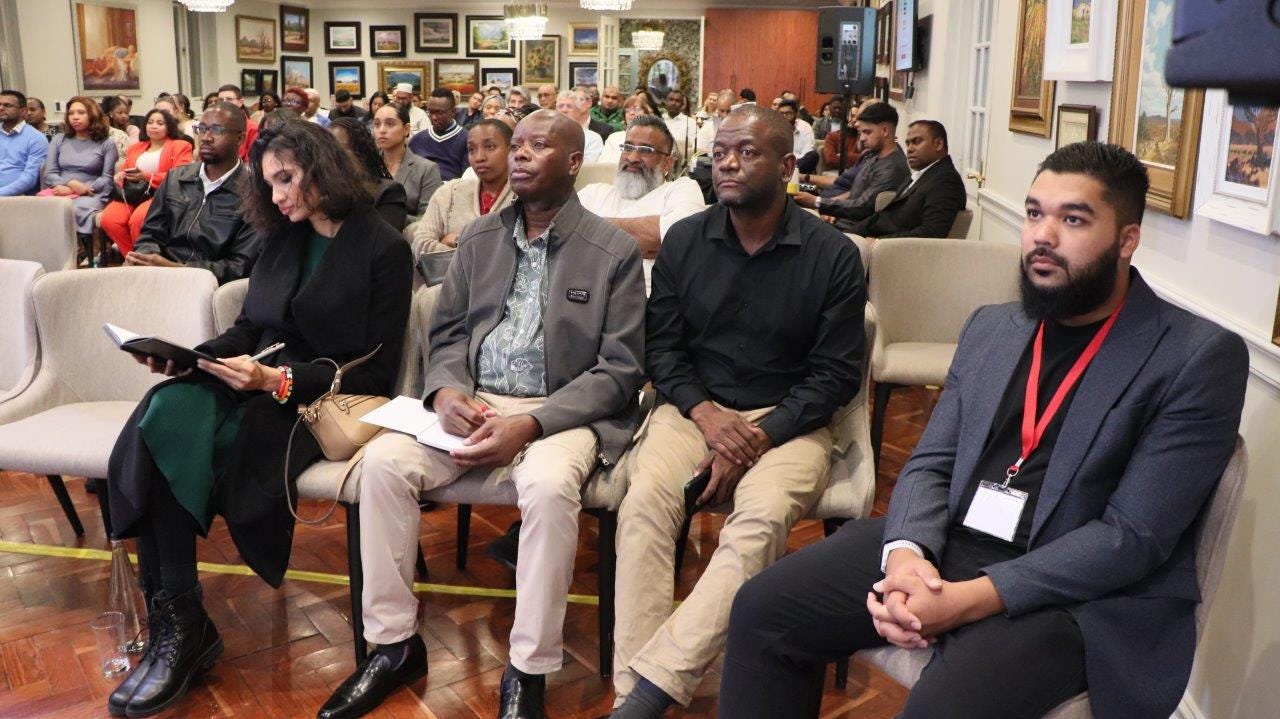
As part of its regular Critical Conversations series hosted around the country, Regent Business School brought award-winning investigative journalist Jeff Wicks together with Academic Dean Dr Shahiem Patel to examine truth, power and accountability, and what these principles demand from leaders and institutions.
These themes shaped Regent Business School’s latest Critical Conversations engagement, where award-winning investigative journalist and author, Jeff Wicks, joined Regent Business School Academic Dean, Dr Shahiem Patel, for a discussion on corruption, institutional failure, public trust and the responsibilities carried by those in positions of authority.
One question surfaced repeatedly during the conversation: what does the right person for leadership actually look like?
Patel says leadership is measured in the decisions people make, the standards they set and the conduct they are prepared to tolerate.
“The people we place in positions of authority shape the institutions they lead,” he says. “Their judgement, integrity and willingness to act when something is wrong have consequences for everyone around them.”
Wicks drew on years of investigative reporting to show how corruption can sit inside ordinary systems, hidden in procurement processes, transactions and institutional routines. His work has also shown the value of people who are prepared to question what they are presented with and keep following the evidence.
The discussion included the case of whistle-blower Babita Deokaran as one example of the risks carried by individuals who expose wrongdoing. Patel says organisations need systems that protect people who speak up and ensure their concerns are acted on. “People need to know that speaking up will lead to action,” he says. “That depends on proper oversight, transparent processes and a culture where concerns can be raised safely.”
Power was another recurring theme. Corruption needs access, opportunity and people inside institutions who enable it, ignore it or fail to stop it. That places scrutiny on appointments, internal controls and what happens when those controls are bypassed.
Patel says leadership education has to confront these realities directly. “Future leaders need to understand what comes with authority,” he says. “The decisions they make, the behaviour they allow and the people they appoint all shape the health of an institution.”
The discussion also focused on practical measures that can make corruption harder to commit and easier to detect.
These included greater transparency in procurement, wider use of electronic systems that leave a clear audit trail, stronger protection for whistle-blowers, accessible reporting mechanisms and meaningful consequences for wrongdoing.
For Patel, prevention starts with the design of the system itself. “Accountability has to be built into the way organisations operate,” he says. “People should know where to report concerns, those concerns should be investigated properly and there must be consequences when misconduct is proven.”
The same principles apply across both public and private institutions. Boards, businesses and organisations all face questions around governance, ethical leadership and whether the people inside those systems feel able to challenge wrongdoing.
The conversation also turned to younger South Africans. An audience member spoke about taking conversations on fraud and corruption into schools with learners aged 15 to 17. Patel noted how troubling it is that these issues already need to be addressed at such a young age, particularly when young people are exposed to displays of wealth linked to questionable conduct and public figures who appear to benefit from wrongdoing.
“We have to reach young people early,” says Patel. “They need examples that show the value of integrity, hard work and accountability, especially when the opposite can appear to offer a quicker reward.”
For Regent Business School, this is one of the reasons Critical Conversations are a necessity. The series creates space for current and future leaders to examine difficult issues with people who have confronted them first-hand. In this discussion, the message was practical and direct: pursue the truth, scrutinise power and build systems that hold people accountable.
Strong institutions depend on people who are willing to act, and on systems that support them when they do.
©Higher Education Media Services.