


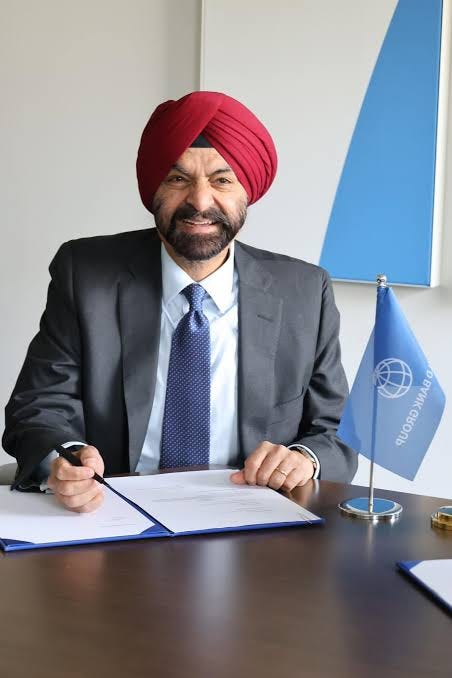
World Bank Group President Ajay Banga has warned that the world faces twin challenges of scarce resources and a looming jobs crisis, but said reforms undertaken over the past three years are beginning to deliver results at scale.
Delivering his plenary address at the 2026 World Bank-IMF Annual Meetings in Bangkok, Thailand, Banga said three truths emerged before he joined the Bank in June 2023: challenges were great, resources were limited, and the institution needed to face the wind.
“Three years later, the wind has not eased. Conflicts persist. Fiscal space is tighter. Debt burdens have risen. And cost of essentials—from energy to fertilizer—remains high,” Banga said.
He highlighted a demographic transformation that will define development for the next century: Over the next 10 to 15 years, 1.2 billion young people will arrive at a job market projected to offer only about 400 million jobs — leaving a gap of roughly 800 million jobs.
“This generation will shape the next century. The choices we make today will help determine how,” he said.
Banga said the Bank’s strategy started with changing itself. Project preparation was cut from 19 months to nine, 153 scorecard measures were replaced with 22 focused on impact, pay-for-results financing increased from about one-third to half, and the balance sheet was reengineered to create more than $100 billion in additional IBRD lending capacity over a decade.
MDB collaboration has also deepened, with the co-financing pipeline tripling in two years to about 250 projects seeking $138 billion in financing.
The jobs strategy rests on three pillars: physical and human infrastructure, regulatory and policy certainty, and scale.
Last year, the Bank committed $40 billion — nearly one-third of its financing — to foundations like electricity, water, transport, digital, health, education and skills. Thirty percent of public sector financing supported policy and institutional reform.
The Private Sector Investment Lab helped focus on barriers like currency risk and access to finance, strengthening tools such as guarantees, equity, and local currency financing.
The results: In FY22, before the workplan began, the Bank mobilized roughly $35 billion in private capital. Last year: $112 billion — a threefold increase. Alongside its own financing, total financing exceeded $230 billion.
Mobilization nearly tripled in lower-middle-income countries, quadrupled in upper-middle-income countries, and more than doubled across Africa. However, in low-income countries, mobilization held at roughly $3 billion.
Participation broadened to investors in 110 countries last year, led by the United States, United Kingdom and India, but also including Romania, Chile, Poland and Brazil.
Nearly 55 percent of financing and mobilized private capital went to infrastructure and energy, agribusiness, health, tourism, and value-added manufacturing. Total World Bank Group climate co-benefits reached $96 billion, with $48 billion from private capital.
Banga said small businesses are central, especially in fragile and conflict-affected settings. The new MSME strategy aims to make firms more visible, connected, enabled and funded using digital records to improve access to finance and markets.
On technology, he distinguished between “Big AI” — which requires computing power, energy and specialized skills beyond many developing countries’ immediate reach — and practical or “small” AI that can help a farmer improve yields or a health worker make better decisions. The Bank is helping countries build electricity, connectivity, device access, safeguards, and skills.
Looking ahead, Banga said the next phase is execution at scale. The Bank is expanding presence in New York, Frankfurt, Milan and Tokyo to originate opportunities.
He argued development finance has faced a constraint that a dollar can only be in one place at a time, while pension funds, insurers and sovereign wealth funds manage enormous pools of long-term capital seeking long-term investments.
Six multilateral development banks are now creating common ways to assess, document, package and transfer investments — so a project financed today can be held by another investor tomorrow, freeing capital for the next project. Repeated across institutions, Banga said this begins to create an emerging-market development asset class.
“If we get this right, the size of our balance sheet no longer defines the scale of our ambition — and we will bend the curve of development forever,” he said.
Closing with reference to the 1944 Bretton Woods conference where 44 nations gathered, Banga said: “They did not build a monument to charity. They built a bank.”
“Today, the challenge arrives as arithmetic: a gap of roughly 800 million jobs. Behind that number is a young woman with a degree and no employer. A young man with a trade and no electricity. A generation asking: is there a place for me? A job is not a statistic. A job is dignity.”
“The future of development will depend on bringing public finance, private investment, philanthropy, and technology together around what each country needs,” he said. “The jobs gap is a projection. It does not have to be our future.”
He concluded: “That future is ours to build. Let. Us. build.”
©Higher Education Media Services.