

By Bismark Tyobeka
Twice in my lifetime, I witnessed South Africa become the centre of the world’s attention. In the final decade of the 20th century, we emerged as a nation determined to lead through moral example, committing ourselves to never again repeat the injustices of our past. Today, as calls for violence against foreigners grow louder, we risk becoming a global cautionary tale rather than an international inspiration.
On 11 February 1990, I sat glued to a television in my sister’s home in the township of Selosesha, Thaba Nchu. I had recently started Standard 8 (Grade 10) at Moroka High School and was spending the weekend away from the hostel. Along with millions around the world, I watched Nelson Mandela walk free from Victor Verster Prison.
Four years later, on 27 April 1994, I stood in a queue at Nonceba Primary School in my home village of Nonceba to cast my first democratic vote. South Africa opened its arms to all who lived in it, and in return, the world embraced us.
Today, more than three decades later, I write, deeply concerned by the growing threat of violence and disruption directed at immigrants. The consequences of such actions extend far beyond those immediately targeted. They threaten the very character of our nation.
Let us begin with an honest acknowledgement: there is no place for illegal immigration. South Africa, like every sovereign nation, has both the right and the responsibility to manage its borders and enforce its laws. We face significant developmental challenges and limited resources, and government has an obligation to prioritise the welfare and security of its citizens.
Yet recent events have presented South Africans with a false choice. We are told we must either condone xenophobia or ignore illegal immigration. We should reject both positions.
When governments fail to manage immigration effectively, migrants often become convenient scapegoats for broader social and economic frustrations. This is neither fair nor productive. Equally, unlawful entry into a country cannot be excused. But violence, intimidation and vigilantism are never the answer. They undermine the rule of law and erode the social fabric that binds us together.
I want to bring this conversation closer to home.
The word university derives from the Latin universitas, meaning “a community united as a whole”. At the NWU, we welcome lecturers, researchers and students from across Africa and beyond because we understand that knowledge does not recognise borders. Scientific breakthroughs emerge through collaboration. Innovation flourishes when people with different experiences and perspectives work together. We have as much to teach as we have to learn.
Our students become stronger graduates because they engage with people who think differently from themselves. A university that isolates itself from the wider world quickly becomes intellectually poorer.
Yet in the current climate, important distinctions are increasingly being blurred. In the public imagination, lawful migrants, refugees, international students, skilled professionals and undocumented immigrants are being grouped together. Once those distinctions disappear, prejudice takes root and reason gives way to fear. That is the dangerous point at which we now find ourselves.
As public universities, we have a responsibility to demonstrate that openness and order are not competing ideals but complementary ones.
Our institutions thrive because they combine openness to people and ideas with accountability, merit and respect for the rule of law. International students obtain the necessary visas. International academics are appointed through rigorous processes and are expected to meet the same standards and comply with the same regulations as everyone else. Openness succeeds precisely because it is supported by clear, fair and consistently applied rules.
Evidence also challenges many of the assumptions that dominate public debate.
A recent article in The Economist highlighted research showing that foreign-born residents account for only about 5% of South Africa’s population. Studies by the World Bank and the Organisation for Economic Co-operation and Development suggest that migrants often create jobs, establish businesses and stimulate economic activity. Other research indicates that foreign nationals are, on average, less likely to commit crime than South African citizens.
These findings may challenge widely held perceptions, but facts matter. A society cannot solve complex problems through misinformation, fear or anger.
The principle of universitas reminds us that humanity advances not by turning away from one another, but by learning from one another. At the same time, strong communities endure because they respect shared rules and institutions. South Africa does not have to choose between openness and order. We need both.
We must reject xenophobia without qualification. We must enforce immigration laws without apology. And we must continue building institutions that welcome talent, ideas and innovation from every corner of the world while remaining firmly grounded in the rule of law.
The colours of our Rainbow Nation appear dimmer than they once did. The dreams of our founders are being deferred. The sacrifices made in pursuit of freedom risk being forgotten, while the values that underpinned our democratic transition are too often neglected or distorted.
More than 11,750 days after I cast my first democratic vote, the ideals that defined our national rebirth — reconciliation over revenge, hope over hatred and unity over division — remain ours to protect.
Let us seize this moment to reaffirm those values. Let us paint a new canvas, brighter and more inclusive than the one before, so that the world may once again see that South Africa is more than a place on a map. It is an idea worth defending and an example worth aspiring to.
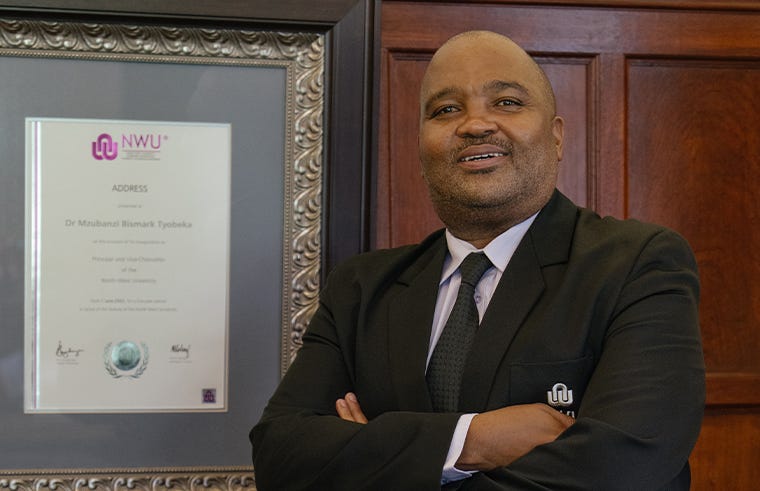
Prof. Bismark Tyobeka, Principal and Vice-Chancellor of the North-West University (NWU).
©Higher Education Media Service.