


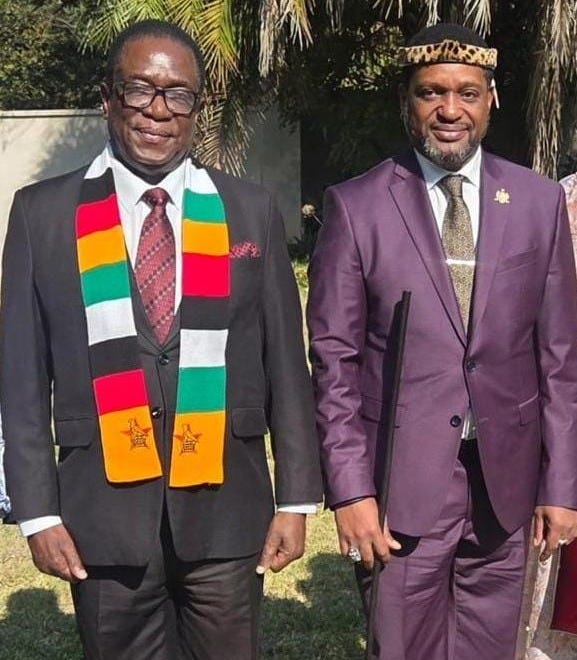
The King of the Zulu Nation Misuzulu kaZwelithini has urged African leaders to balance compassion with governance in managing migration, during a landmark visit to Zimbabwe over the weekend where he emphasised shared history, mutual respect, and the sovereignty of nations.
“I come to Zimbabwe not merely as the King of the Zulu Nation, but as a son of Africa who believes that our continent’s greatest strength lies in our shared history, our shared humanity and our shared responsibility to one another,” the King declared in his keynote address.
On Thursday IOL reported that the King led a delegation including AmaMpondo King Ndlovuyezwe Ndamase from the Eastern Cape as well as other traditional leaders from other provinces, to Zimbabwe to meet with president Emmerson Mnangagwa to address illegal immigration issues.
The newspaper quoted Ndamase saying: “I cannot divulge the agenda of the meeting before it takes place, however, I can assure the public that the issue of illegal immigration is on the agenda”.
Issues around illegal immigration affecting mainly South Africa have been a hot topic internally and among many African countries, especially Zimbabwe, Mozambique, Malawi and Nigeria, ever since disgruntled South Africans took to the streets, marching against the government for keeping our borders porous.
Irate South Africans through organisations such as March and March have been protesting against the presence of millions of undocumented and illegal migrants that are a strain to the economy of this country, including a burden to health facilities, schools and the infrastructure.
The protesters set a 30 July deadline for all illegals to leave South Africa and created a repatriation crisis for many countries around SADC, with thousands of migrants still stranded at camps set up in the country to deal with the crisis.
In a speech delivered in Zimbabwe over the weekend, the Zulu monarch underscored the deep ties between South Africa and Zimbabwe, describing the two nations as “family” whose histories have been intertwined for centuries.
He reminded his audience that African identity has never been confined to colonial borders, citing historical figures such as Chief Mzilikazi and Soshangane who established communities across Southern Africa.
“Being family does not exempt us from respecting one another’s homes. On the contrary, family respects family,” he said, stressing that respect for immigration laws is essential to preserving both dignity and sovereignty.
The King rejected polarized narratives around migration, cautioning against both xenophobia and lawlessness. “Violence against any innocent person, regardless of nationality, can never be justified. Equally, no sovereign state should be expected to abandon the enforcement of its immigration laws out of fear of being labelled xenophobic,” he said.
He argued that the real challenge facing Africa is not xenophobia but governance. “When borders are poorly managed, when documentation systems fail, when corruption enables unlawful entry… communities inevitably lose confidence in the ability of institutions to maintain order,” he warned.
Proposing a continental framework to address migration, the King outlined principles including respect for sovereignty, modern border management, stronger cooperation against document fraud, lawful labour migration agreements, and humane returns of those residing illegally. He also called for joint investment in economic development to reduce poverty-driven migration.
“Africa does not need open borders without accountability. Africa needs lawful mobility. Africa needs secure mobility. Africa needs managed mobility,” he said.
The King emphasized the role of traditional leaders in bridging governments and communities, promoting lawful migration and social cohesion.
“Traditional leadership can become a bridge between governments and communities by promoting lawful migration, social cohesion and peaceful coexistence,” he noted.
Concluding his speech, the King reaffirmed his visit as one of friendship and unity. “May future generations say that when Africa was confronted with difficult questions about migration, we did not allow division to define us.
Instead, we demonstrated the courage to distinguish between lawful migration and illegal immigration. We strengthened the rule of law without abandoning the spirit of Ubuntu.”
©Higher Education Media Services